

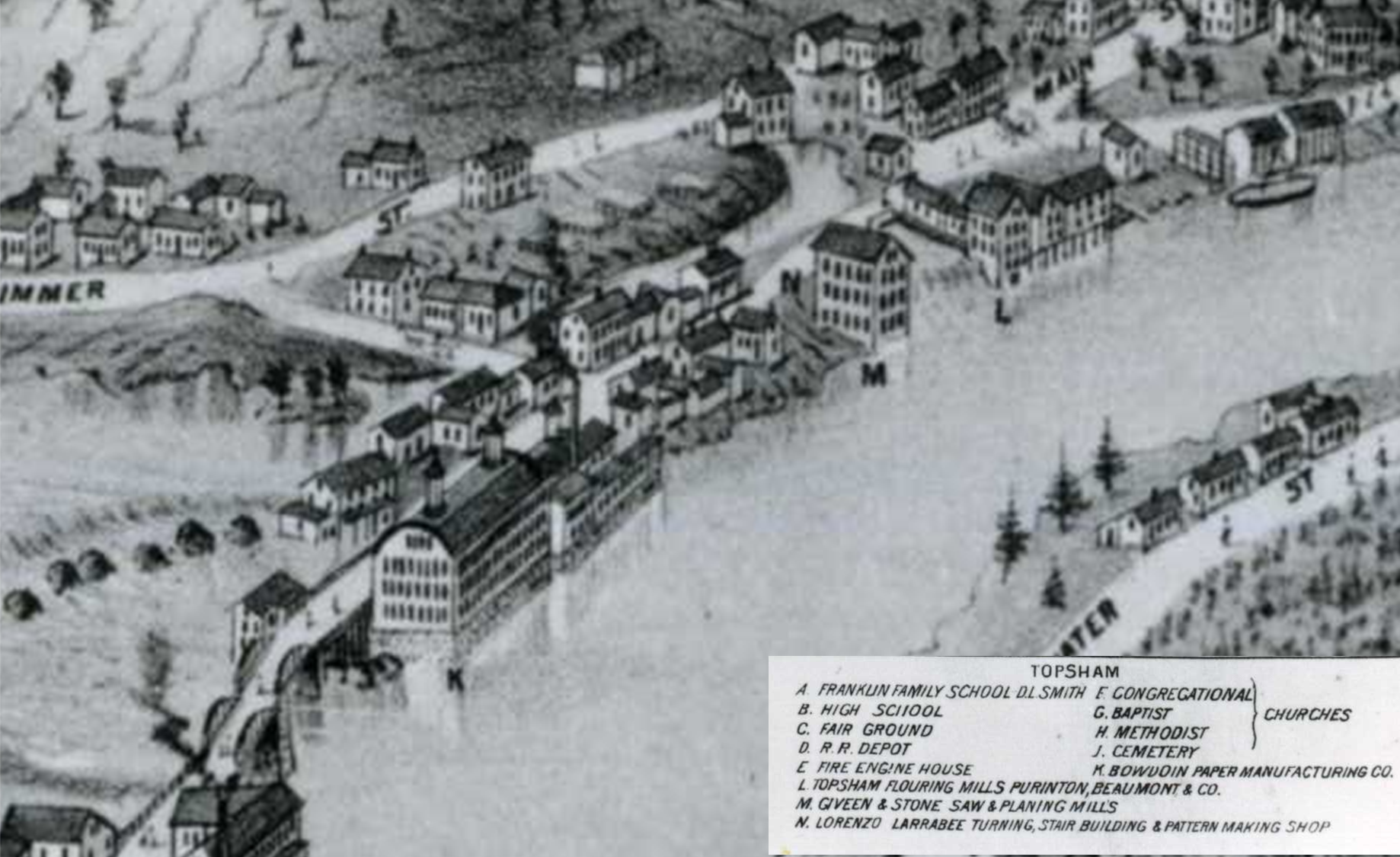
Mill island detail from 1877 Brunswick-Topsham
Topsham was approved as an incorporated township in 1764. European settlement was established in the 1715 to 1725 period when homesteads were established on 100 acre lots along the lower Androscoggin River. During this period, the developer, the Pejepscot Proprietors, built and leased the region’s first sawmill at the head of tide on the Cathance River. By 1753 dams and business enterprises were being built at the falls on the Androscoggin River, and were to be followed by more dams and businesses in ensuing years. During this time, Granny Hole Stream was opened by excavation and accommodated more industrial activity in the waterway it created. The first bridge between Brunswick and Topsham was built in 1796 further enhancing business development along the falls on the Androscoggin.
By 1802 there were 46 buildings in Topsham’s growing village area; the 28 homes and 18 businesses Included five mills, six stores, a cabinet making shop, a blacksmith shop, a courthouse and a school. These buildings were along the streets in the lower village section and along Elm Street.
Written articles on the early history of Topsham suggest the years from 1798 to 1808 and shortly afterwards, leading up to the War of 1812, were some of the most prosperous for the town as shipping and shipbuilding flourished. In the early to mid-19th Century, it was manufacturing businesses powered by water in the Lower Village which flourished. The population of Topsham doubled between 1802 and 1850 from about 1,000 to 2,000 people. This also was when the homes of the wealthy began to be separated from those of more modest means. A grand residence on an elevated terrace was the ideal Federal Style property, and several were built along Main Street, Green Street, Pleasant Street, Winter Street, and Elm Street. This was the age of the building of large ornate homes and created what is now referred to as the historic district of Topsham.
As in so many New England communities, religion played a major role in the lives of Topsham residents. The Congregational Church, the original religion of Massachusetts, was also the principal religion of Maine, a district of Massachusetts until 1820. Topsham’s Congregational Church was built at the corner of Green Street and Elm Street about 1830 by renowned builder Samuel Melcher III. It was later used as Topsham’s Town Hall until it was destroyed by fire in the 1960s. A very similar church, the First Baptist Church, was built by Melcher one block away at the corner of Elm and Main Street in 1835 where it continues to stand. The Free Will Baptist Church was constructed on Winter Street in 1837 and demolished in the 1970s. Another Christian-based sect got its start in the 1840s in Topsham. A young lady named Ellen White who lived in Gorham was visiting her friends, the Howlands, at 7 Elm Street in Topsham. It was here in 1847 that she had the vision which confirmed her beliefs and established her as one of the founding members of the Seventh Day Adventist Church.
By 1853 the Central Village had grown to more than 150 buildings and the Federal Style gave way to the Greek Revival style of design. The published Brunswick Topsham’s birds eye view of 1877 shows the village south of Melcher Place largely as it exists today with about 180 buildings and three churches. The brick building of the Bowdoin Paper Company Mill was the largest building in town. A railroad depot was located at the east end of the village on Elm Street across from the entrance for the fairgrounds.
Feldspar was mined in Topsham from about 1870 to about 1940 along the Cathance and Tedford Roads. The Maine Feldspar Company located on the eastern end of Elm Street near the railroad tracks had the capacity to process 40 tons of spar per day and employed 75 people. At one time Topsham produced 1/8 of the feldspar used in the USA, and 1/16th of that used worldwide.
Feldspar mining and Topsham’s mills played a big role in the ever-changing immigrant population of Topsham. Italians who knew the mining trade well were brought over and lived in communities near today’s Tedford Road and Cathance Road, often sending their earnings back home to families in Europe. After the walking bridge, or the swinging bridge as some called it, was built over the Androscoggin River, French Canadian families moved to the Topsham Heights area and were within comfortable walking distance to the mills on both sides of the river. An expansion of Pejepscot Paper, the successor to the Bowdoin Paper Co., occurred around 1900 with a new plant on the Androscoggin River at Pejepscot Falls. Shortly, many Eastern Europeans immigrated to the village to work at the mill and to form what is now known as Pejepscot Village.
New construction occurred less often during the Victorian era, but Summer Street saw several houses in the Queen Anne style including expanded and renovated Federal Style capes. Many older homes were updated with Italianate door hoods, bay windows and porches. Styles continued to change, but many of the original homes remain which is why today in Topsham’s Historic District you’ll find a Federal home next to a Greek Revival home with an Arts and Crafts bungalow nearby.
A prominent part of the early town was the annual Topsham Fair held every year since its origination in 1856. It was started by the Sagadahoc Agricultural and Horticultural Society. Its early exhibitions featured livestock and produce, with handcrafts and other arts soon added. The Topsham Fairgrounds Grandstand was built in 1864. It is listed on the National Register of Historic Places.
World War II and the Cold War brought military bases to the Brunswick Topsham area, and included an Air Force installation in Topsham known as the Sage Base. Many of the servicemen and women introduced to the area as assigned military personnel ended up residing in Topsham at the completion of their assigned service.
The town has shifted over time from a community with agriculture and manufacturing as its base to a more residential and retail town. But Topsham retains many small businesses, and a large rural district. It is a small, quirky, unique town which has reinvented itself several times, and is partly made up of residents who can trace their roots back several generations. Residents enjoy the ever-evolving history and culture of a town with a small town feel ever welcoming to new residents from near and far.