Here’s Emily’s favorites from 2022!


Sam’s picks are:



Here’s Emily’s favorites from 2022!
Sam’s picks are:
Here are Tami’s top reading for 2022!

The Rockton Series by Kelley Armstrong

And by Anne LaBastille
Here are Cyndi’s picks:
Teen


Adult


We’re a little late with our top picks this year, so as it is February, we thought we’d keep with the theme and tell you the books (and media), the Topsham Public Library staff loved last year!
From Jennifer:
In no particular order here are my top picks of 2022:

Extraordinary, Ordinary People by Condoleezza Rice
The story of growing up Black and female in the United States in her own words.
Ain’t Burned All the Bright by Jason Reynolds, illustrated by Jason Griffin
Reynold’s poetry is succinct and all the more striking for it. He hits you right in the heart.

The Distant Land of My Father by Bo Caldwell
A beautifully written story about the father/daughter relationship.

The Road Dance by John MacKay
Set in Scotland as the Great War begins, a young woman’s future is upended by acts of violence near and far, and the fallout from those actions takes a toll on all.
All the Living and the Dead by Hayley Campbell
An interesting, gruesome, and yes, comforting, look at those who handle the body after death.
From Linda:

The Murder of Mr. Wickham by Claudia Gray
This was a delightful read. The setting is a house party at a country estate in England in 1820. A number of the guests are characters drawn from the novels of Jane Austen, including Fitzwilliam and Elizabeth Darcy, and Colonel Brandon and his wife Marianne. The house party had just gotten underway when Mr. Wickham, (from Pride and Prejudice) walks in uninvited. It seems everyone there has reason to hate him. When he turns up dead, there is no lack of suspects. Ms. Gray captured the mood and manners of the Regency Era very authentically, from my meagre knowledge, and I was happily immersed in the lives of the inhabitants of the house. With so many suspects, it was a challenge to discover the murderer, and it was near the end that I finally figured it out. Reading this book was a wonderful escape from the 21st century. I thoroughly enjoyed it.

The Bullet that Missed by Richard Osman
The third book in the Thursday Murder Club reunites us with the lovely characters at the Cooper’s Chase Retirement Village. These characters sneak right into your heart and take hold there. There are plenty of laughs and many poignant moments too. I laughed out loud and cried a little too. If you’re of a certain age, you will recognize yourself here, and if you’re young and want to understand your parents or grandparents, this is the book to read. To top it all off there is a thoroughly enjoyable mystery, as well. Prepare to be entertained.

Before She Disappeared by Lisa Gardner
Frankie Elkins is an alcoholic. She’s in recovery, but every day brings a new challenge to decide to stay sober, and her past is dragging her down. To keep her own demons at bay, Frankie chases other demons. She finds missing people., 14 so far, but none of them alive. She’s getting desperate. She needs a win, even more than she needs a drink. There is a teenage Haitian girl in Boston, who has been missing for months. The police have gotten nowhere. But there is something about Frankie. She somehow knows the right questions, and begins to get answers. There is way more to this story than originally thought, and Angelique isn’t the only girl missing. The police think Frankie is in way over her head, and perhaps she is. The danger gets closer and closer. Will Frankie get the girls back alive, or will she join the missing?
We regularly have patrons looking for DVDs and Blu-rays with closed captioning or subtitles, and while it should be clearly indicated on the case, it isn’t always so easy to tell exactly which service is available. Looking them up in our library catalogue is another way to tell. It should list the features in the note and subject sections. See the screenshot below as an example:
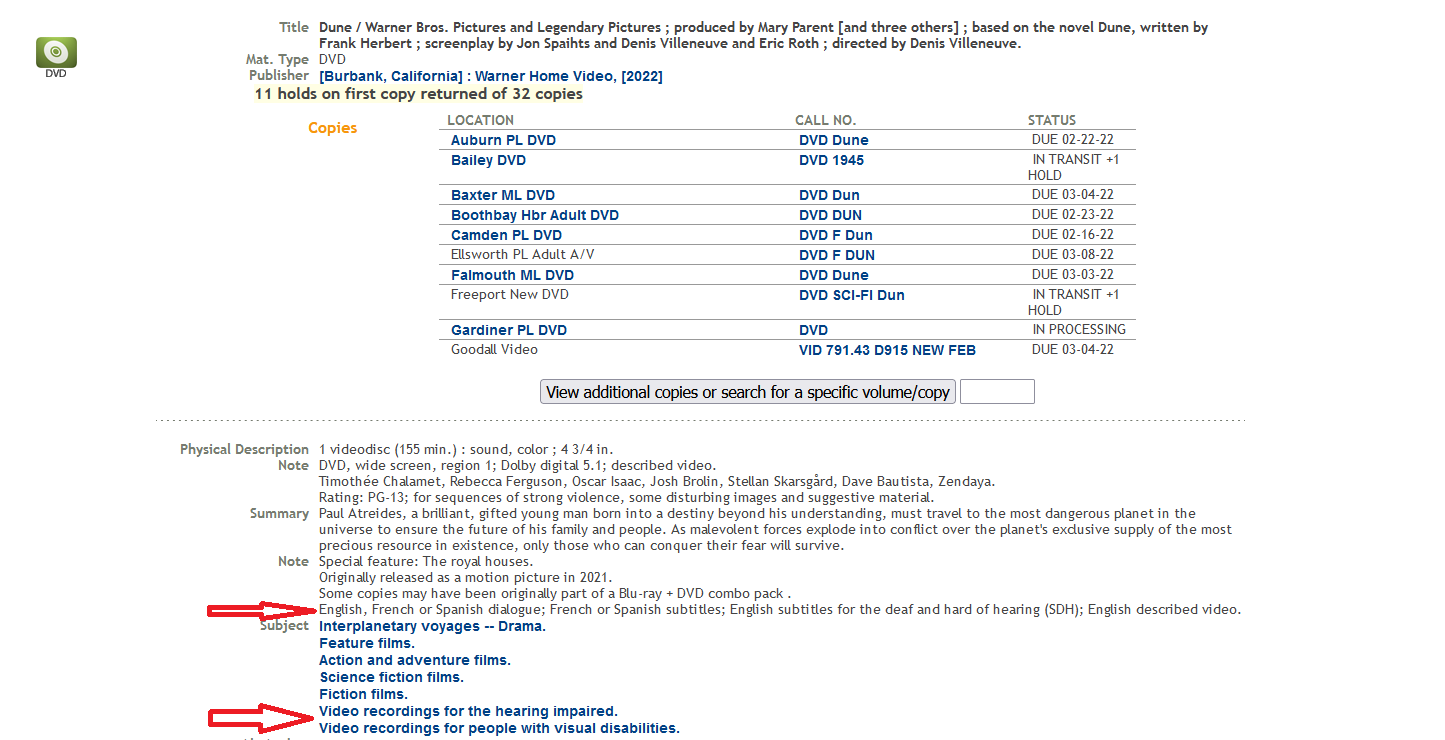
While closed captioning and subtitles are similar, there are differences in intended purpose as well as features. In looking further into it, we have learned a few things that we’d like to share.
Closed Captioning (CC)
Closed captioning (CC) was developed to help ensure accessibility for individuals that are deaf or hard of hearing. Closed captions involve transcriptions of dialog – the conversion of audio into text form in the exact wording that the original speaker used. They also communicate other audio such as sound effects, speaker IDs, and non-speech elements. “Closed captions should account for any sound that is not visually apparent but is integral to the plot. For example, the sound of keys jangling should be included in closed captions if it is important to the plot development – like in the case where a person is standing behind a locked door.” source

Subtitles
Intended for viewers who can hear but do not speak/understand the language used in a video, subtitles are translations – an interpretation to convey meaning, not exact wording – of video dialogue into other languages so that audiences all over the world can watch videos, movies, and more in their native language (or language of choice). They communicate spoken content only, not non-speech elements such as sound effects, and are synchronized to media files so that they play at the same time as the spoken word.

Now that we have touched on the differences between CC and subtitles, let’s look at a couple of other accessibility options…
Subtitles for the Deaf and Hard of Hearing
Subtitles for the Deaf and Hard of Hearing (SDH, SDHH) are written for viewers who may not be able to hear the audio and combine the information of both captions and subtitles. SDH contains information about background sounds and speaker changes, along with a translation of the script.
How is it different from closed captioning?
– The biggest difference is that the two are encoded differently and closed captioning is not supported by High Definition Media Interface (HDMI), while regular subtitles and SDH are. Therefore, SDH can be found on many more types of media such as streaming internet videos and Blu-ray DVDs.
– There is also a difference in appearance. Traditionally, closed captions have been formatted as white text on a black background that can be positioned anywhere on the screen. In contrast, SDH is usually text overlaid directly on the video and is found on the bottom third of the screen and can vary in color.
Remember we just said that closed captions are not supported by HDMI? If you are trying to access this feature on a DVD that says it has “CC” but can’t seem to make it work, this is why – the signal is in an older format which is incompatible with today’s technology. SDH has been replacing closed captioning on newer DVDs due to the easier access. If you don’t see the “CC” symbol, look for the SDH abbreviation.

Descriptive Audio
Descriptive audio enables individuals who are blind or have low vision to hear a spoken narration of a movie’s key visual elements including actions, settings, facial expressions, costumes, and scene details & changes. Descriptive audio supplements the regular audio track of a program and is usually added during existing pauses in dialogue.
Here is a short example from Lion King that will give you a clear sense of what this service offers.
This feature goes by many labels including English descriptive audio (the most common), English described audio, audio described English, video description, described video… you get the point.
The Audio Descriptive Project is a very thorough online resource about this service and maintains a list of DVDs with audio description.

We hope you have found this information helpful. Please do let us know if you have any questions.
This is the final installment of staff picks from 2021. We hope you have enjoyed this glimpse into some of our favorite reads, listens, and watches from last year.


This is the next to last installation of staff favorites from last year and in this roundup we share top picks from Mariah, Cyndi, and Dale.


Wink : surviving middle school with one eye open by Rob Harrell


Ted Lasso, Apple TV series


Teen Fiction:


Teen Graphic Novels:


Adult Non-Fiction:

Later this week, for the final installation of Staff Picks, we’ll learn the 2021 favorites of Linda and Monique.
We are back to share more of our staff picks from 2021. In this round we hear from Julie, Emily, and Jen.
Who needed some happy endings…


Books:


Movies:

Podcasts:


Audiobooks:


It is just about time to say a proper goodbye to 2021 and that means it’s time to reflect on some of our favorite reads (or listens or watches). Have we read something out of our genre comfort zones? Have we been exploring particular interests? Were we in need some feel-good stories? Let’s find out by taking a look at our staff’s favorite picks from the past year. We’ll begin with Lindsay, Emma, and Tami…


Next time we’ll share top picks from Julie, Emily, and Jen. In the meantime, if you have some favorites from 2021 that you’d like to share, drop them in the comment box below.

Our word for August, sagacity, means incisive wisdom or sharp discernment; the quality of having or showing understanding and the ability to make good judgments (source); the quality of being wise and farsighted (source).
One famous example of its usage comes from Mary Shelley in Frankenstein: “I had sagacity enough to discover that the unnatural hideousness of my person was the chief object of horror with those who had formerly beheld me.”
Another comes from Les Misérables by Victor Hugo: “With the sad and innocent sagacity of childhood, Cosette measured the abyss which separated her from that doll.”
Some sources say that the first recorded use of sagacity comes from the 15th century and others state that in the 17th and 18th centuries, sagacity was used to refer to an animal’s acute sense of smell. For example, Merriam-Webster states, “Sagacious entered the English language around the beginning of the 17th century and, for some decades, referred to perceptiveness of sight, taste, and especially, smell. One of the first authors to use the word, Edward Topsell, wrote in 1607 of bees searching for something with “a most sagacious smelling-sence.”
While the word is used differently today, you could say that if you have sagacity you are able to sniff out good ideas from the bad.
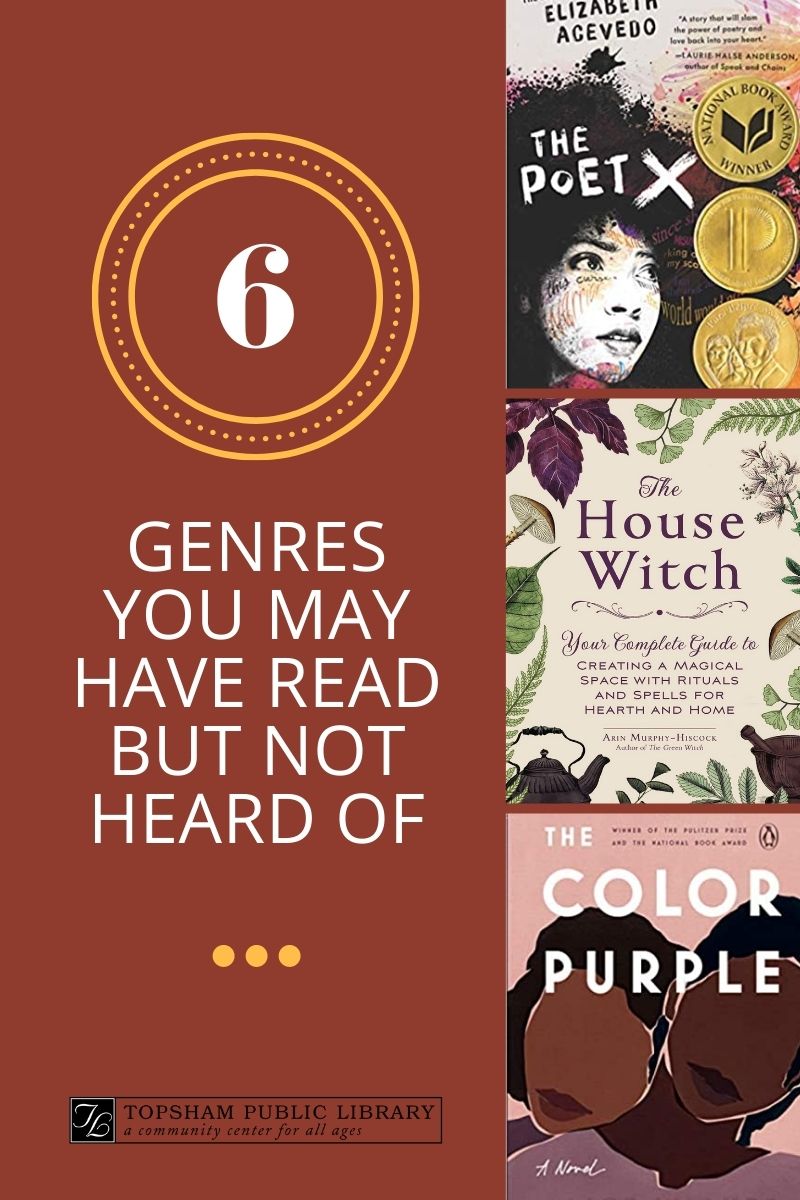
A search on genres of literature will get you a multitude of responses: what the main genres are, how many main genres there are, whether or not there are sub-genres or only categories of main genres. The perspective of the TPL librarians? Genres and various sub-genres can be very helpful in identifying your interests and finding your next read (but do not feel limited by them).
Whatever your opinion on the matter may be, here are 6 sub-genres you may have read but haven’t heard of…
Cli-fi: Cli-fi stands for climate fiction and is literature that deals with the effects of climate change on human society. It has been growing in popularity, especially among high school and college-age readers, and there are many colleges now offering cli-fi courses. There’s a good selection to choose from here.
Bildungsroman: These are coming of age stories – bildungsroman (German) is a compound of the words bildungs, meaning “building or formation”, and roman meaning “a novel”. (source) Chances are you have read at least a few of these novels. To Kill a Mockingbird, The Catcher in the Rye, Little Women, and The Alchemist are some examples.
Mannerpunk: A cousin of steampunk, mannerpunk is a subgenre of fantasy literature that takes place within an elaborate social structure and resembles a comedy of manners. The Night Circus by Erin Morgenstern and Stardust
by Neil Gaiman are two examples that might be familiar to you.
Grimoires: Though perhaps not exactly a literary (sub)genre, grimoires—manuals of magic or witchcraft— has had a recent resurgence can be found on the shelves of many a witch, sorcerer, or amateur spell caster. (source) We have several in our collection.
Epistolary: An epistolary novel is a story told exclusively through fictionalized letters, emails, newspaper articles, and other primary sources. The form experienced a popularity surge in the mid-1700s, and it has since structured some of the most beloved books in the English language, such as Dracula and The Color Purple.
Verse Novel: Fiction novels are usually written in prose (verbal or written language that follows the natural flow of speech). Verse novels tell a story, with the character development and narrative structure of novels, but in the form of long poetry. It does not have to rhyme but it does often have a cadence and/or use other poetic devices. You’ll find some examples here.
There you have it – some familiar titles that fall under some less familiar categories. Do you have a favorite genre or sub-genre? Let us know in the comments.
